5 Signs You Need Brake Repair and Why Bloomingdale, IL Drivers Shouldn't Wait
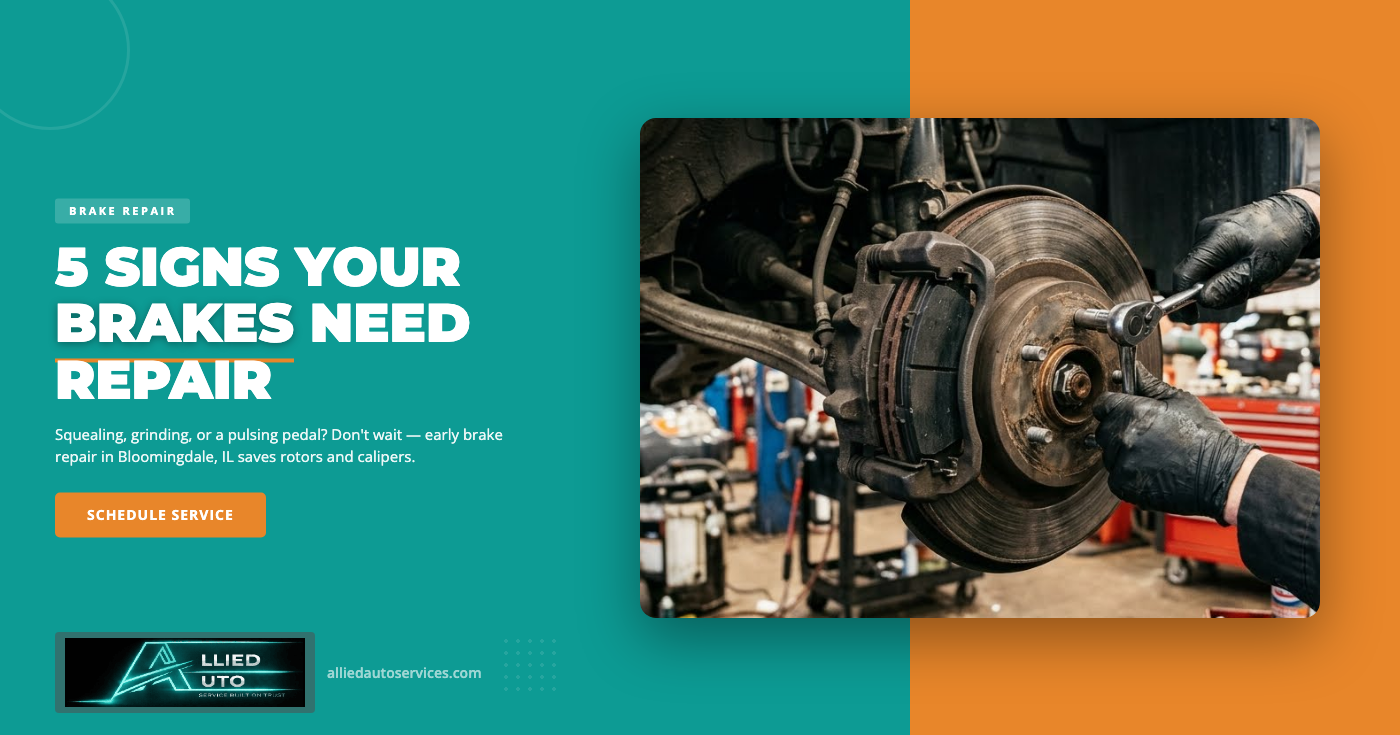
When the brake pedal in our Bloomingdale, IL driveway feels different than it did last month, that small change is the brake system asking for attention. Brakes are the only thing standing between a normal commute down Lake Street and a fender-bender at the next red light, and they almost always warn us before they fail. The trouble is that most of those warnings get easy to ignore — a faint chirp at low speed, a quick shudder when slowing for the Army Trail Road exit, a pedal that feels just a little softer than it used to. None of those symptoms guarantee a crisis tomorrow. All of them mean the system has started to wear, and waiting almost always turns a routine fix into a much larger repair bill.
We work on brakes every single day at our shop in Roselle, just minutes from Bloomingdale, and the same patterns come up over and over: drivers who heard a noise weeks ago, drove on it for another month, and now need pads, rotors, and sometimes a caliper instead of the simple service they could have had. This guide walks through the five signs we wish every Bloomingdale driver recognized early, what to expect from a real brake inspection, and how to know when brake repair in Bloomingdale, IL has shifted from “schedule this soon” to “do not drive another mile.”
5 Warning Signs Your Brakes Need Attention
Most brake problems announce themselves long before the system fails. Here are the five signals that should always trigger a brake inspection near Bloomingdale.
1. A high-pitched squeal when slowing down
Modern brake pads are built with a small metal tab called a wear indicator. As the friction material wears thin, that tab makes contact with the rotor and creates a high-pitched squeal — almost a chirp — anytime the brakes are applied. The noise is engineered to be annoying for a reason. It is the pads telling us they have less than a few thousand miles of life left. A squeal that lasts more than a day or two is the cue to book Bloomingdale brake service before the next sign on this list shows up.
2. A deep grinding noise
Grinding is the sound of metal on metal. Once the friction material on the pad is fully gone, the pad backing plate grinds directly against the rotor surface. We can hear it, we can feel it, and the damage compounds with every stop. A car that was a straightforward pad replacement last month often becomes a pad-and-rotor job once grinding starts. If a vehicle is grinding when it brakes, drive directly to a brake repair shop in the Bloomingdale area or have it towed.
3. A pulsing or shuddering brake pedal
If the steering wheel or pedal shakes when the brakes are applied at highway speed, the rotors have most likely warped or developed an uneven thickness. This often follows hard, repeated braking — the kind that happens on the I-355 or I-290 ramps during rush hour — or driving through a deep puddle while the rotors are hot. Mild pulsation can sometimes be machined out; severe pulsation usually means new rotors. Either way, the symptom does not heal itself.
4. A soft, low, or sinking brake pedal
A pedal that feels mushy, drops closer to the floor than it used to, or slowly sinks while held at a stoplight points to a hydraulic problem. The cause is usually air or moisture in the brake fluid, a leaking line, or a failing master cylinder. This is the warning that bothers us the most as technicians, because it indicates the system can no longer build proper pressure. Any change in pedal feel deserves immediate attention from a brake repair shop in Bloomingdale, IL.
5. The car pulls to one side when braking
If the steering wheel tugs left or right under braking, one front caliper is doing more work than the other. Common causes include a stuck caliper slide, uneven pad wear, a collapsed brake hose, or contaminated fluid. Pulling under braking is more than an annoyance — it shortens stopping distance on the side that is working harder and can cause uneven tire wear within a few hundred miles. Have it diagnosed before the next long drive.
Why Bloomingdale Drivers Shouldn’t Delay Brake Service
Bloomingdale sits at the intersection of suburban commuter routes, big-box retail traffic, and seasonal weather that punishes brake systems. Stop-and-go traffic on Lake Street, Army Trail Road, and Schick Road wears pads roughly twice as fast as highway cruising, because each light cycle is a fresh application of friction. Then add winter. Road salt accelerates rotor corrosion, especially on vehicles that sit through long cold snaps, and that rust creates the pulsation and uneven pad wear we end up chasing through spring and summer.
Waiting also escalates cost. A worn pad alone is usually the least expensive brake job we perform. Once the pad is gone and the rotor has been scored or overheated, we are replacing pads and rotors together. If the caliper has been dragging because of contaminated fluid or a stuck slide, we may be replacing all three. The same vehicle that needed a simple pad service in May can need a full corner overhaul by August, and that escalation is almost always avoidable. Acting early on brake repair in the Roselle area protects both the wallet and the rest of the vehicle.
What Happens During a Professional Brake Inspection
When a customer brings a car in for a brake inspection near Bloomingdale, we do not just glance at the pads through the wheel. The full process takes the wheels off and looks at every component that affects stopping power.
We measure pad thickness in millimeters at the leading and trailing edges. We mic the rotors to compare current thickness against the manufacturer’s minimum and check for runout that causes pulsation. We inspect the calipers for leaks at the piston seal, look for cracked or swollen flex hoses, and exercise the caliper slides to confirm they move freely. We pull a sample of brake fluid and test it for moisture content, because fluid that has absorbed water boils at a lower temperature and turns mushy under heavy use. Finally, we check the parking brake mechanism, since a seized parking brake cable can drag a rear pad for thousands of miles without anyone noticing.
Because we use digital inspections, customers receive photos and measurements directly to their phone before any work begins. There is no guesswork and no upsell pressure — just clear documentation of what we see, what is within spec, and what needs attention. That transparency is the part of brake repair in Bloomingdale, IL that builds the trust customers come back for.
Brake Pads vs. Rotors: Understanding the Difference
It helps to know what we are talking about when an estimate lists pads, rotors, or both. The brake pad is the wear item: a backing plate with friction material bonded to it that presses against the rotor to slow the wheel. Pads are designed to be consumed over time. The rotor is the spinning metal disc the pad squeezes; rotors wear more slowly but do wear, and they can warp from heat or scorching from a worn-down pad.
Several years ago, machining (resurfacing) rotors was a routine part of brake pad replacement in the Bloomingdale area. Many modern rotors are now manufactured with so little extra thickness above the legal minimum that there is nothing left to cut. In those cases, new pads on old rotors creates noise, vibration, and short pad life almost immediately. We measure every rotor before we recommend pads-only versus pads-plus-rotors. If a rotor is above minimum thickness, has even wear, and no heat damage, pads alone are the right call. If it does not meet those criteria, replacement is the honest answer — even if it costs a little more up front, it costs much less than a comeback in 5,000 miles.
How Long Do Brakes Typically Last?
The most common question we get is how often brakes should be replaced. The honest range across modern vehicles is roughly 25,000 to 70,000 miles for front pads and longer for rear pads, but the spread is huge because three factors dominate.
The first is driving style. A driver who anticipates traffic and coasts to a stop will get nearly double the pad life of a driver who brakes hard at the last second. The second is terrain and traffic. Pads on a Bloomingdale commuter who fights I-355 traffic every day wear noticeably faster than pads on a vehicle that mostly sees open highway out near DeKalb. The third is vehicle weight. Heavier SUVs and trucks — especially when towing or hauling — load the front brakes harder, and front pads on those vehicles often need replacement around 30,000 miles.
Rear brakes generally last longer because the front brakes do roughly 70 percent of the stopping work. The exception is vehicles with electronic parking brakes or rear-biased brake systems, where rear pads can wear surprisingly fast. The only way to know where a specific vehicle stands is a measured inspection, which is why we recommend a free visual check at every oil change and a full measured inspection any time one of the five warning signs above shows up.
Why Choose Allied Auto Services for Brake Repair in the Roselle Area
Brake repair is one of those jobs where it really matters who turns the wrench. The parts are not the whole story — the diagnosis, the measurements, the torque specs, the bedding-in procedure, and the follow-up all separate a brake job that lasts from one that comes back. We have been doing this work in the Roselle and Bloomingdale area since 2001, and the way we approach every brake repair reflects what we have learned in those years.
Every job at Allied Auto Services is performed by ASE-certified technicians and backed by a 3-year/36,000-mile warranty on parts and labor. We use digital inspections so customers see exactly what we see — photos of pad thickness, rotor condition, and fluid quality before we recommend anything. Most brake repairs dropped off before 11 a.m. are completed the same business day, which matters when a household has only one vehicle and an evening pickup line to make. Our shop in Roselle is a short drive from Bloomingdale, Itasca, Glendale Heights, and Carol Stream, and we work on virtually every make and model that comes through the door.
Above all, we will tell a customer when a brake job is not necessary. If the pads have plenty of life left and the noise is something else entirely, we say so. That “Service Built On Trust” tagline is not marketing — it is how we keep families returning to us for every vehicle, every season. To see the full list of what we offer, visit our services overview, or book a brake inspection directly through our brake repair page.
If any of the five warning signs in this article sound familiar, schedule an inspection before the next sign joins them. A measured look today is almost always the lowest-cost path to confident, quiet stopping for the rest of the year.