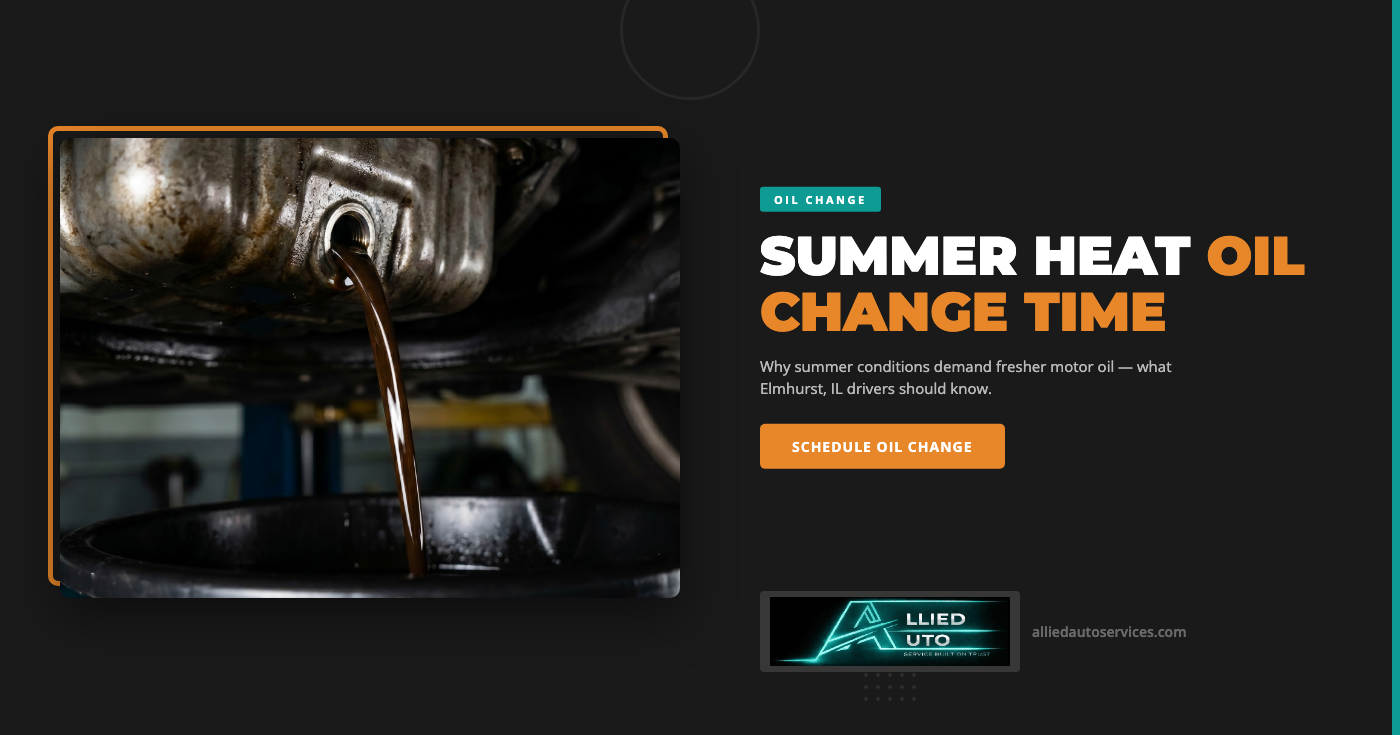
Summer Heat and Oil Changes: What Elmhurst, IL Drivers Should Know
Every July and August, our service bays fill with the same complaint: dashboard oil warning light on, engine feeling sluggish after a run down I-290, or oil that comes out of the pan looking closer to coffee than honey. Elmhurst, IL sits in the heart of the DuPage County commuter belt — York Road, North Avenue, and the daily stop-and-go on I-290 and I-294 are exactly the driving conditions that push motor oil past what it was engineered to handle. When Elmhurst highs push into the mid-80s and humidity drives the feels-like temperature into the mid-90s, the oil under your hood is working much harder than it did in April.
At Allied Auto Services, we have been the oil change elmhurst il drivers count on since 2001. This guide walks through what summer heat does to motor oil, how often we recommend changing oil this season, which grade holds up better in Illinois heat, and the warning signs that mean your car needs an oil change today.
Why Summer Heat Puts Extra Strain on Your Oil
Motor oil has one primary job: coat the moving parts of your engine with a thin, consistent film so metal never touches metal. Every oil formulation is engineered around a specific viscosity range — the "5W-30" or "0W-20" printed on the bottle tells you how the oil flows when cold (the first number) and how it holds up when hot (the second). When ambient temperatures climb, engine operating temperature climbs with them, and the oil begins to thin out.
Thin oil forms a weaker film. That film is what keeps the crankshaft, camshaft, and piston rings from grinding against their bearings. Based on published lubrication research from the American Petroleum Institute, motor oil begins to break down rapidly above 248°F, and the rate of oxidation roughly doubles for every 18°F rise in oil temperature. On a 90°F Elmhurst afternoon in I-290 traffic with the A/C running, oil temperatures can climb well above what the oil was tested against during highway driving in cooler weather.
When oil oxidizes, it forms sludge and varnish deposits that clog oil passages, restrict pickup screens, and stick to piston rings. The additive package — detergents, dispersants, and anti-wear compounds — depletes faster in heat as well. That is why an oil change interval that looked comfortable in April can leave the oil dangerously thin by August.
How Often Elmhurst, IL Drivers Should Change Oil in Summer
The oil change interval printed in your owner's manual assumes typical driving conditions. In Elmhurst, IL, summer driving usually is not typical. Short trips through downtown Elmhurst, stop-and-go on I-290 during rush hour, and idling in DuPage County heat all fall into what manufacturers call "severe service" — a category that shortens the recommended interval significantly. Here is how we walk our Elmhurst customers through the numbers:
- Conventional oil in normal service — typically 3,000 to 5,000 miles or 3 to 6 months, whichever comes first.
- Conventional oil in Illinois summer severe service — closer to 3,000 miles, especially if most trips are under 10 miles or include heavy stop-and-go traffic.
- Full synthetic oil in normal service — 7,500 to 10,000 miles depending on the vehicle and manufacturer specification.
- Full synthetic oil in summer severe service — closer to 5,000 to 7,500 miles, and always by the time the dashboard reminder calls for it.
If your daily driving includes long idles in traffic, towing to a lake weekend, or extensive short trips where the engine never fully warms up, the interval should trend toward the shorter end. On our digital inspection report, we include oil-condition photos so you can see the color and consistency of what came out of the pan.
Synthetic vs Conventional: Which Handles Illinois Heat Better?
The single biggest question we get on an oil change in Elmhurst, IL is whether the upgrade to full synthetic is worth it. In Illinois summer conditions, the answer is almost always yes.
Conventional motor oil is refined from crude petroleum, and even after refining it contains molecular structures with different heat tolerances. When the oil sees sustained temperatures above 200°F, the less-stable molecules break down first, forming the oxidation byproducts that create sludge. Full synthetic oil is engineered from uniform molecular building blocks with far better thermal stability. It holds its viscosity longer in heat, resists oxidation better, and keeps the engine cleaner over the entire drain interval.
The tradeoff is cost per change — synthetic runs roughly two to three times the price of conventional. But the interval extends by two to three times as well, so on a per-mile basis the two are often comparable. For older engines built before synthetic became common, we generally recommend a synthetic blend as a middle ground; for anything built in the last decade, most manufacturers now specify full synthetic anyway.
The important point is the API specification. The current gasoline engine standard is API SP, and as long as the oil on the shelf carries the current API donut, the certification meets modern engine requirements. The synthetic-versus-conventional decision comes down to how well the oil holds up between changes, especially in the summer heat.
5 Warning Signs Your Car Needs an Oil Change Now
The dashboard oil light is the last warning, not the first. By the time it comes on, oil pressure has usually dropped below what the engine needs and damage may already be starting. Here are the earlier signs we tell every Elmhurst driver to watch for:
Dark, gritty oil on the dipstick. Fresh oil is amber and transparent. As it does its job, it darkens — that is normal. What is not normal is oil so dark you cannot see through it, or oil with visible grit when you rub a drop between two fingers. That is oxidized oil carrying particulate that should have been changed several thousand miles ago.
Louder engine noise, especially at startup. A ticking, tapping, or knocking sound that was not there a few weeks ago is often thin oil failing to fill the clearance between valve lifters, bearings, or timing chain guides. Startup noise that lasts more than a second or two is a warning that oil is not reaching the top of the engine fast enough.
The smell of burning oil. If your car smells hot after a highway run, or you catch an oil scent through the vents, oil is likely reaching a hot component — often a valve cover gasket, a leaking rear main seal, or an exhaust manifold splashed by a leak elsewhere. Oil-starved bearings can also emit a hot, acrid smell distinct from a normal warm engine.
Low oil level between changes. Every engine uses a small amount of oil over its drain interval. Excessive consumption — needing to add oil between changes — means oil is burning past worn rings, leaking past seals, or evaporating in extreme heat. Any of those is a reason to have the engine inspected.
Dashboard oil-life reminder or pressure light. Every modern vehicle has an oil-life monitor that calculates change intervals based on driving conditions. When it says the oil is at 0%, believe it. If the actual pressure-warning oil light comes on with the engine running, stop and shut off the engine — driving even a mile with low oil pressure can total an engine.
What Happens When You Skip Oil Changes in Summer Traffic
The most expensive engine repairs we see are almost never a single failed part. They are the result of oil left in the engine too long, thinned out in the heat, and no longer protecting bearings and cylinder walls that were doing their job under normal conditions.
When oil oxidizes and sludge forms, that sludge coats the oil pump pickup screen. A partially blocked screen restricts flow — the pump cannot draw enough oil to maintain pressure, and the engine bearings run dry for milliseconds at a time. Over weeks of driving that way, bearing surfaces score, crankshaft journals wear, and the engine develops the low-end knock that signals a four-thousand-dollar-plus short-block replacement.
Timing chain wear is another common consequence. Modern engines rely on oil pressure to keep the timing chain tensioner extended. When oil thins in Illinois summer heat or the level drops between changes, tensioner pressure falls, the chain rattles at startup, and eventually skips a tooth — an event that can cause valves and pistons to collide and take out the entire top end of the engine.
Neither failure happens in one hot afternoon. They happen slowly, over a summer of skipped oil changes and thinned oil, until the engine cannot recover. The math strongly favors the oil change — a routine service versus a repair bill that can rival the value of the vehicle.
Choose a Trusted Local Auto Shop for Your Oil Change in Elmhurst
Every oil change at Allied Auto Services includes far more than draining and refilling. Our ASE Master-certified technicians perform a digital multi-point inspection at every service — checking tire tread, brake pad thickness, belts and hoses, coolant, battery charge, and all major fluid levels. Every finding is documented with photos and sent to your phone so you can see the actual condition of the car alongside the shop's recommendations.
We have earned the trust of Elmhurst, IL drivers because our technicians are not paid on flat rate or commission — no one in the building has a financial incentive to recommend a repair that is not necessary. What you see on the digital inspection is what we would tell a family member to fix, in the order we would fix it. Every repair carries a three-year, 36,000-mile parts-and-labor warranty.
Our full oil change service covers conventional, synthetic blend, and full synthetic in the grade your manufacturer specifies. If you are keeping the car for the long haul, our preventative maintenance program pairs oil changes with the fluid, brake, and belt intervals that keep major repairs from ever landing in your lap.
Common Questions About Oil Changes in Elmhurst, IL
Can I go longer between oil changes if I only drive short distances? No — short-trip driving is actually harder on oil than highway driving. The engine never gets hot enough to burn off moisture and fuel contamination, and the additive package depletes faster. Short-trip drivers should change oil closer to the shorter end of the recommended range.
Does the oil life monitor on my dashboard know when the oil is bad? The monitor is a calculation based on driving conditions and engine load, not an actual oil-quality sensor on most vehicles. It is a good general guide, but if the oil looks black and gritty on the dipstick before the monitor calls for a change, trust what you see.
Do I need to change the oil filter with every oil change? Yes. The filter captures the particulate the oil picks up over the interval, and leaving an old filter in place means the new oil is filtered through a contamination-loaded element from the start.
Is it fine to switch from conventional to synthetic on an older car? In most cases yes, but on very high-mileage engines with worn seals, synthetic can sometimes reveal small leaks that heavier conventional oil was masking. We walk through that tradeoff on a per-vehicle basis during your inspection.
How long does an oil change take at your shop? A standard oil change with digital inspection runs about 45 minutes. If the inspection turns up something that needs attention, we walk you through scope, timing, and cost before doing any additional work.
If it has been more than 3,000 miles or three months since your last oil change, or if any warning sign above sounds familiar, contact Allied Auto Services for an oil change in Elmhurst, IL. We will change the oil, run a full digital inspection, and give you a clear picture of what your car needs to make it through the rest of the Illinois summer.