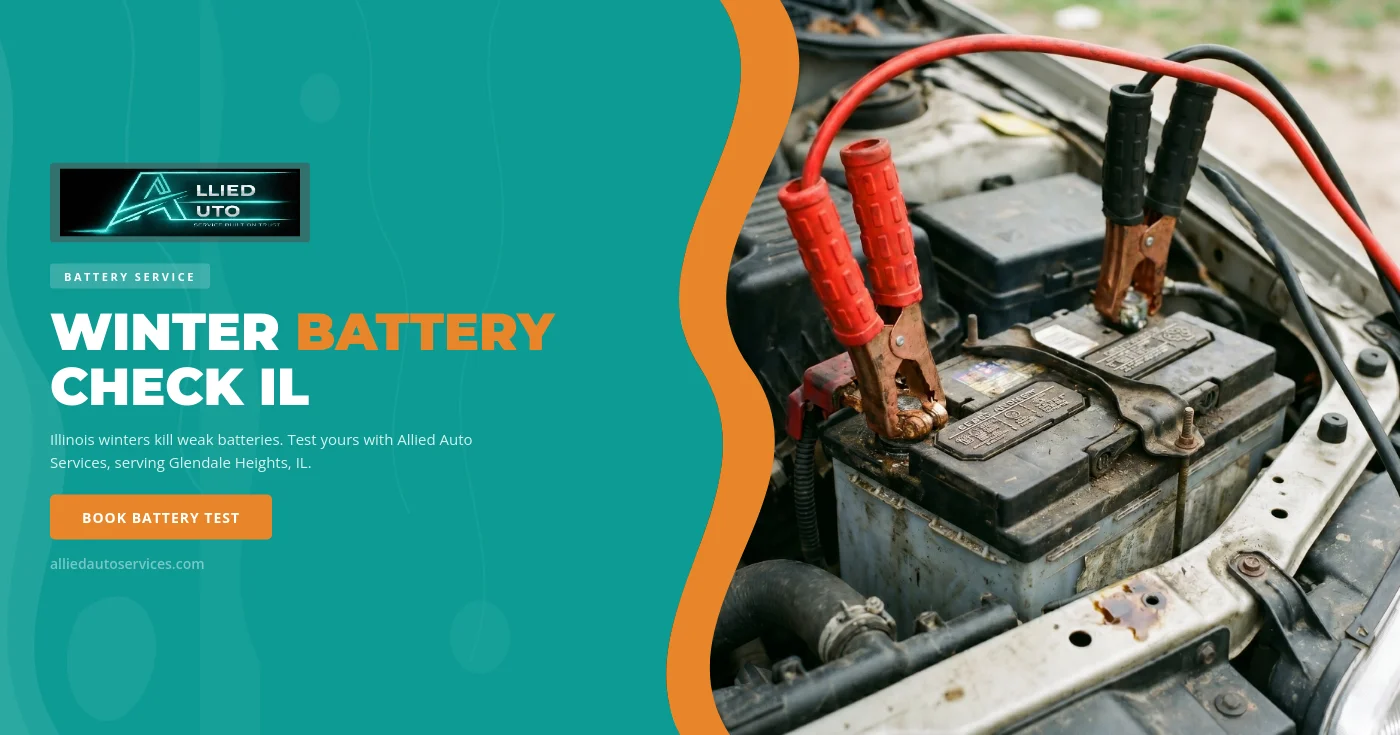
Why Glendale Heights, IL Drivers Should Test Their Car Battery Before Illinois Winter
When the first truly cold morning arrives on North Avenue and the dashboard clock reads 24 degrees before the sun is up, the component most likely to leave a Glendale Heights, IL driver stranded is the one almost no one thinks about until it fails — the car battery. The engine still has oil, the brakes still have pads, the tires still have tread. But the battery that cranked a warm engine fine in July has quietly been losing capacity all year, and the first hard Illinois cold snap is what finally exposes it. That is why a professional battery service in Glendale Heights, IL before winter arrives is one of the smartest preventive calls a driver can make this season. At Allied Auto Services, our neighbors count on us for careful Battery & Electrical Service, digital inspections with photos and short videos sent right to your phone, and straightforward pricing that never has surprises attached — and pre-winter is our busiest battery season for very good reason.
Why Illinois Winters Are Especially Hard on Car Batteries
Illinois does not do winter in moderation. A typical year in Glendale Heights, IL moves from mild autumn afternoons in October to overnight lows in the teens by December, and when the real cold arrives it tends to arrive hard — single-digit lows, wind chills well below zero, and occasional polar-vortex stretches where the temperature does not climb above freezing for days at a time. Every one of those cold hours changes the chemistry inside a lead-acid battery, and every cold start demands more current than the battery was ever asked to deliver in July. That is why a battery that performed perfectly through summer can quietly fail on the first truly cold morning of the year.
There is also a geography piece Glendale Heights, IL drivers feel personally. Most of our vehicles sit outside overnight — in a driveway off Fullerton Avenue, in a townhome lot near Bloomingdale Road — and lose temperature all night. By the time a 6 a.m. commute begins, the battery is at or near the coldest reading of its day. We are not asking it to start at a 60-degree afternoon. We are asking it to start at the hardest moment of its day, every day, for four straight months. A pre-winter battery service in Glendale Heights, IL is our chance to confirm the battery is ready before January forces the conversation on a shoulder of I-355 instead.
How Cold Temperatures Drain Battery Power Faster Than You Think
The physics of a cold-weather no-start is less mysterious than it looks from the driver's seat. A lead-acid battery produces current through a chemical reaction between its lead plates and sulfuric acid electrolyte, and that reaction slows dramatically as temperatures drop. At 32 degrees, a healthy battery delivers roughly 65 percent of its rated capacity. At 0 degrees — a reading Glendale Heights, IL sees on plenty of January mornings — the same battery delivers closer to 40 percent of what it offers on a warm day. The battery is not broken; it is simply chemically slower, and that means less current is available at exactly the moment the engine needs more current to crank.
And it needs more current in the cold for a reason that compounds the problem. Engine oil thickens as it chills, and a starter fighting syrupy oil has to pull substantially more amperage to turn the crankshaft. The battery is giving less, the starter is asking more, and the gap shows up as a slow, lazy cranking sound on a January morning — the kind of start that eventually becomes a click-and-nothing. This is why the industry rates batteries by Cold Cranking Amps, or CCA: the number tells you how many amps the battery can deliver at zero degrees Fahrenheit for 30 seconds without voltage falling below usability. A battery whose CCA has drifted below the vehicle's requirement can crank a warm engine easily all summer, then fail its first real cold-start without warning. Short winter commutes make it worse — a drive from Glendale Heights, IL to a nearby job never gives the alternator enough time to fully replace what the cold start pulled out, so the battery leaves the garage less charged than it arrived every single morning.
Warning Signs Your Battery May Fail Before Winter Hits
Batteries almost always warn Glendale Heights, IL drivers before they quit — the signs are quiet but consistent, and knowing what to listen and look for is half the battle. The clearest early signal is a cranking sound that has gotten noticeably slower in the past few weeks. A healthy starter cranks a warm engine in a crisp half-second; a battery losing capacity makes that half-second longer, with a lazier, lower-pitched rotation. Headlights that look dim at idle but brighten slightly when you rev the engine are another classic clue — the alternator is picking up the slack because the battery alone no longer has the muscle to hold steady voltage. Interior and dashboard lights that visibly dip during the start sequence are telling you the same story.
There are visual clues too. A yellowish-green or chalky white crust on either battery terminal is corrosion from off-gassing — a sign of a battery working harder than it should, or an aging connection costing cranking amps. A case that looks visibly swollen on the sides or top usually means the battery has been overcharged or lived through enough heat to warp the plastic, and that shortens its remaining life quickly. A battery light on the dashboard, even one that flickers briefly during start-up, is the vehicle's computer saying the charging system has noticed something out of range. For start-stop vehicles, a system that suddenly refuses to shut the engine off at a red light is almost always the software deciding the battery no longer has the reserve to restart cleanly. Any one of these signs is a reason to book a battery service in Glendale Heights, IL this week rather than next month.
What a Professional Battery Test Reveals About Your Vehicle
A professional battery test is more than a glance at voltage. When our ASE Master-certified technicians put your vehicle on the lift, we test the battery, the charging system, and the starting system as one connected set — because that is how they actually work together on the road. We begin with a resting voltage reading for state of charge, then run a load test using a carbon-pile or electronic conductance tester that applies a controlled load for a measured period and watches how voltage holds. A battery that falls below roughly 9.6 volts under load is telling us one hard cold morning could finish it. We also measure actual CCA against the vehicle's required rating; the first number is what the battery can really deliver today, the second is what the vehicle will ask of it on a cold January commute.
From there, we test the alternator's output at idle and at higher RPM to confirm it is charging within specification — too low and the battery slowly starves between drives, too high and the battery boils off electrolyte and cooks the plates. We measure voltage drop across the battery cables and ground connections, where plenty of cold-weather no-starts quietly hide: a slightly corroded ground strap can look fine at 70 degrees and become the limiting factor at 10 below. We check for parasitic draw with the vehicle off, because a glovebox light that will not shut off or an aftermarket amplifier wired incorrectly can pull enough current overnight to leave a strong battery flat by sunrise. The Car Care Council puts it clearly: your "starting and charging systems, and the battery, help ensure dependable vehicle operation whenever you drive your car and in all sorts of driving conditions." You can read more in their vehicle systems overview, and every battery service we perform in Glendale Heights, IL includes a digital walk-around with photos and short videos sent straight to your phone — so you can see the voltage readings, the terminal condition, and anything else we found with your own eyes.
When to Replace vs. Recharge Your Car Battery
Not every battery that measures low needs replacing — and this is where honest, test-driven information matters most. A battery that is simply discharged after a week of short winter trips, a dome light left on overnight, or a vehicle that sat for a month at O'Hare parking can often be recharged on a shop-grade smart charger and come back to full service. Recharging is the right answer when the battery is young (typically less than three years old), has passed its load test, shows no physical damage, and the root cause of the discharge is identifiable and correctable.
Replacement is the right answer when the battery is older than three to five years, when a load test shows it cannot hold voltage under demand, when actual CCA has dropped meaningfully below the vehicle's requirement, or when the case shows swelling, cracking, or terminal damage. For Glendale Heights, IL drivers the pre-winter decision point is especially practical: a battery that passes a June test by a narrow margin is a replacement candidate before November, because that same battery at zero degrees in January will not pass. A planned, in-shop battery replacement at a known cost on a Tuesday afternoon costs a fraction of a jump-start, a tow, a diagnostic, and a replacement under duress on a sub-zero Saturday morning. Pre-winter is the moment to make that call on your terms rather than the weather's.
How Allied Auto Services Your Battery in Glendale Heights, IL
The drive from Glendale Heights, IL to our Roselle shop on Lake Street is a short one — just a quick trip north — and it is the trip that has quietly saved our Glendale Heights neighbors real money and real worry every winter for twenty-five years. Since 2001, Allied Auto Services has been the family-owned shop that Glendale Heights, Roselle, and the surrounding DuPage County communities count on for auto repair done right. Our ASE Master-certified technicians are not paid on flat-rate commission, which means there is no built-in incentive to recommend battery service, or any other service, that your vehicle does not actually need. When we tell a Glendale Heights, IL driver the battery has to come out, it is because the load test and the digital inspection told us so — and we can show you the readings.
Every battery service at our shop includes that digital inspection, straightforward pricing before any work begins, and a three-year, 36,000-mile warranty on parts we install. If your vehicle needs to stay with us for the day, we offer loaner and rental cars so a battery service in Glendale Heights, IL never leaves you without a way to get around. We are a Costco Auto Care Center partner, which means Costco members get an added layer of value on qualifying work — and every customer, member or not, gets the same no-upselling culture our neighbors have counted on since the day we opened. A fresh battery is only one piece of a vehicle that is truly ready for Illinois winter; it works best paired with sound Preventative Maintenance, so the alternator, cables, grounds, and short-trip charging patterns all support the battery rather than quietly working against it. If your vehicle is cranking slower than it used to, if the dash is throwing a battery light, or if the odometer is telling you the current battery has already seen three or four Illinois winters, do not wait for the first polar-vortex morning to force the appointment. Book a pre-winter battery service in Glendale Heights, IL with Allied Auto Services today, and head into the cold season with peace of mind that your first cold start of January will be as effortless as your last one in July.