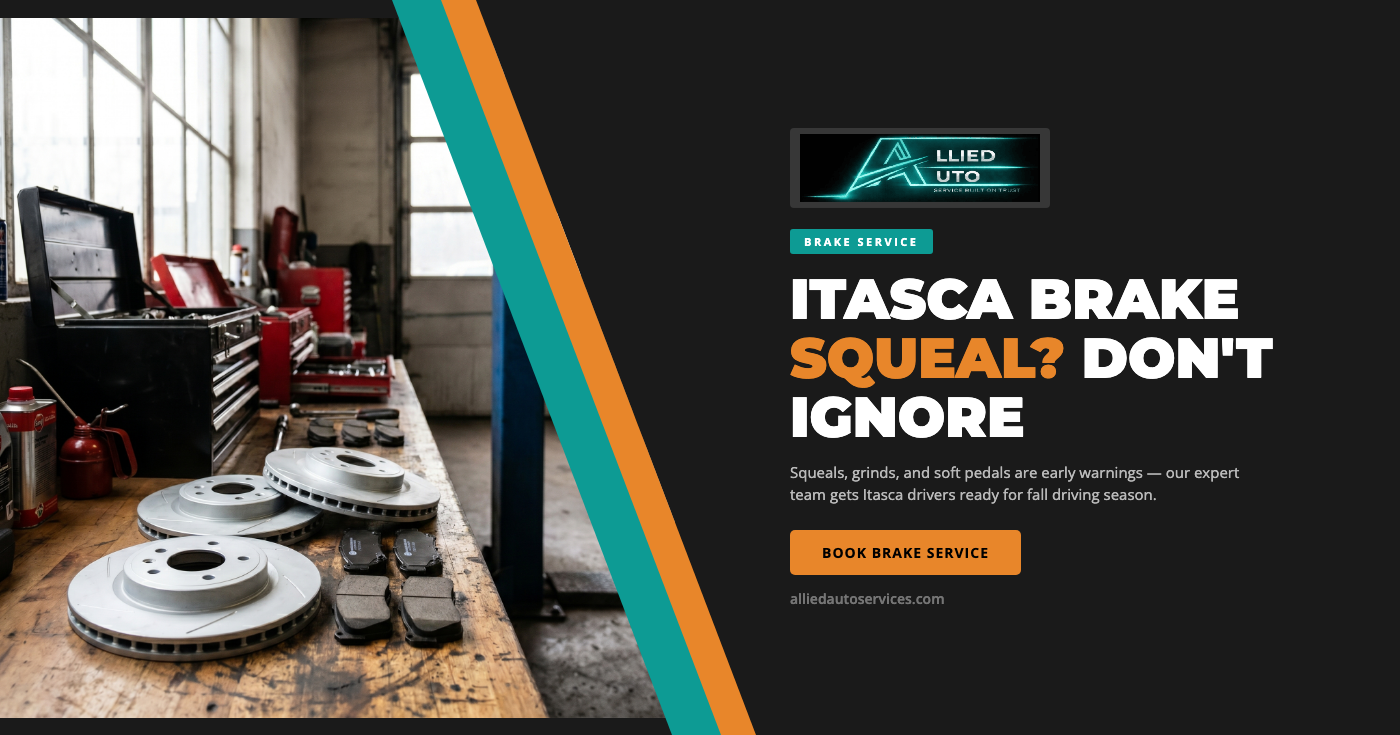
Squealing Brakes? What Itasca, IL Drivers Need to Know Before Fall Road Season
A high-pitched squeal every time you tap the pedal is one of the first warning signs your car sends you, and in Itasca, IL, it tends to show up right when the weather starts to shift. As fall arrives, wet leaves, cooler mornings, and rain-slicked pavement on Irving Park Road and I-290 all put fresh demands on your braking system. At Allied Auto Services, we help Itasca drivers keep their brakes performing through every season, and fall is one of our busiest windows for Brake Service. The good news is that a squeal caught early is often an easy fix. The important news is that ignoring one can turn a routine brake service visit into a much larger repair — and quietly cut into the peace of mind you want behind the wheel. Here's what that noise is really telling you, why the fall season matters in Itasca, and what to watch for before your next drive.
Why Illinois Fall Road Conditions Are Hard on Your Brakes
Itasca sits between the Elgin-O'Hare Expressway and I-290, with plenty of daily driving on side streets, retail strips, and busy commuter routes. Fall in the Chicago suburbs changes what your brakes are being asked to do, and it does it fast. Morning temperatures drop into the 40s while afternoons still climb into the 70s, and that swing means condensation builds on rotors and calipers overnight. When you tap the pedal on your way out of the driveway, the first few stops are noisier and less crisp than they were in July.
Then there's the debris. Wet leaves, twigs, and road grit collect on the surface of Itasca streets through October and November, and any of it can find its way into a brake caliper or wedge against a rotor. Rain that falls on top of that debris turns a dry stopping distance into a longer one, which puts more thermal load on pads and rotors every time you slow down. For Itasca drivers who commute west toward Elgin or east into the city, that adds up over a single week of miles.
Fall is also when we start to see the cumulative damage from summer heat. A season of hot rotors, expanding fluid, and long highway drives leaves brake components in a different condition than they were in the spring. Pads that were "still good" in June often turn out to be much thinner in September, and rotors that felt fine at 75 degrees start to reveal grooves or hot spots once cooler air stops masking the vibration.
Warning Signs Your Brakes Need Service Now
A squeal is the most familiar warning sign, but it's far from the only one. The Car Care Council lists brake pulling to one side, an illuminated brake warning light, low pedal feel, hard pedal feel, vibration, brake grabbing, and squealing as the classic set of symptoms that a professional inspection is overdue. If any of these show up on your Itasca commute, they're worth taking seriously the same week — not the same season.
The squeal itself usually comes from a small metal wear indicator that's built into the brake pad on purpose. It's designed to contact the rotor and make noise once the friction material has worn down to a specific thickness. That noise is your car's way of telling you the pad still has a little life left — but not much. Ignore it, and the next sound you hear is a deeper grinding as the pad's backing plate starts contacting the rotor directly. The Car Care Council warns drivers never to put off routine inspections to the point where the brakes reach "metal-to-metal," a stage where the repair almost always grows from pads alone into pads plus rotors, and sometimes calipers as well.
Other signals matter too. A steering wheel that pulls left or right often points to uneven pad wear or a stuck caliper. A shimmy through the pedal at highway speed usually means a warped or unevenly worn rotor. A low, spongy pedal that sinks toward the floor can indicate air or moisture in the brake fluid, or a leak in the hydraulic line. And any brake warning light on the dash should be treated as a same-day event.
The AAA Club Alliance puts it simply: there's no such thing as a trivial brake issue. Modern brake systems fail gradually, and the earliest signs are subtle. Itasca drivers who notice small changes and act on them almost always spend less than drivers who wait for a hard failure.
How Long Do Brake Pads Last for Itasca, IL Drivers?
The honest answer is "it depends" — and that's not us dodging the question. Brake pad life is one of the most variable numbers in car ownership, because it's driven by how and where you drive. As a general benchmark, most modern pads last somewhere between 30,000 and 70,000 miles. For a lot of Itasca drivers, real-world pad life lands closer to the middle of that range, but we regularly see both ends of it.
The Car Care Council notes that pad wear is influenced by driving habits, operating conditions, vehicle type, and the quality of the brake lining material itself. Aggressive stops shorten pad life quickly, but so do long stretches of stop-and-go traffic — the kind Itasca drivers hit on Irving Park Road at rush hour or on I-290 approaching Chicago. Every stop transfers a tiny amount of pad material onto the rotor. Multiply that by hundreds of daily stops, and the math is easy to see.
Vehicle weight matters too. A large SUV or a loaded pickup wears through pads faster than a small commuter car, because there's more mass to slow down. The pad material also plays a role: organic pads tend to wear faster but stay quieter, ceramic pads last longer and produce less dust, and semi-metallic pads bite hard but shorten the life of the rotor they're paired with. Different vehicles are engineered for different materials, and swapping in a "better" pad without matching it to the system can backfire.
Fall driving in Itasca tends to push mileage toward the tighter end of the range. Wet roads mean longer stopping distances, cold rotors mean rougher initial engagement, and weather delays mean more time in traffic. If your last brake service in Itasca was at the 30,000-mile mark and you're now approaching 55,000 or 60,000, fall is the right window for a fresh inspection — regardless of whether the pedal still feels normal.
Brake Repair vs. Full Brake Replacement: What to Expect
Not every brake visit ends with new components. One of the questions we hear most from Itasca drivers is what the difference is between a repair and a replacement, and the honest answer is that a proper inspection tells you which path your car actually needs — not the other way around.
A brake repair is the more targeted work. It might mean cleaning debris out of a caliper, lubricating slide pins, adjusting a parking brake cable, or bleeding air from the hydraulic system. On some vehicles, a repair fixes an early-stage squeal without replacing the pads. On others, it addresses a specific caliper or line issue while pads and rotors are still within spec. Repairs like these are almost always the least expensive path, and when a component still has plenty of life left, replacing it "just in case" wastes your money.
A full brake replacement is a bigger scope of work — new pads on all four wheels, new rotors as needed, and new hardware to make sure the fresh components seat correctly and wear evenly. It's the right call when pads are near or past the wear indicator, when rotors are grooved beyond the manufacturer's minimum machining thickness, or when calipers are sticking in ways that make replacement more reliable than a repair. On many modern vehicles, we recommend replacing pads and rotors as a matched set, because worn rotors will chew through new pads much faster than they should.
Where we spend the most time with Itasca customers is explaining which components have life left and which don't. Because our technicians aren't paid on flat-rate commission, there's no incentive to push a full replacement when a repair does the job. We show you the wear measurements, walk you through the options, and give you a clear estimate before any work begins. That's how we've built 25 years of Allied Auto trust with drivers across Itasca, Roselle, and the surrounding communities.
What Allied Auto Inspects During Every Brake Service
Every brake service at our shop starts with a full inspection — not because it's a checkbox, but because a thorough inspection is the only way to know exactly what your car needs. We follow the same process the Car Care Council recommends, then add the details specific to how you drive in Itasca and across the northwest suburbs.
Our ASE Master-certified technicians start with a pad thickness measurement on all four wheels, comparing the current reading against manufacturer specifications. We check the rotor surface for wear grooves, hot spots, or warping, and we measure rotor thickness against the minimum machining specification. We inspect the calipers to confirm they're moving freely, examine the brake hoses and lines for cracks or bulges, and check the brake fluid level and condition — moisture-contaminated fluid can compromise braking performance long before you notice any symptom at the pedal.
Every inspection includes a digital report with photos and short video walkthroughs sent directly to your phone. You see what we see. When a rotor has a groove, you get a photo of that groove. When a caliper slide pin is sticking, we show it to you. There's no guesswork, no vague explanation of "we found some issues" — just clear, transparent findings you can act on with confidence.
Because we're a family-owned shop, not a national chain running on a corporate playbook, we take the time to explain what we find. If your pads are at 50% and your rotors are clean, we tell you they're fine — no upsell for services you don't need. If something is close to end-of-life and needs planning, we tell you that too, along with a realistic timeline. Every part we install is backed by our 3-year/36,000-mile warranty, and if your car needs to stay with us, we offer loaner and rental vehicles so a brake service in Itasca never leaves you stranded.
Book Your Brake Inspection in Itasca, IL Before Fall Season
Fall in Itasca doesn't wait for anyone. Wet leaves, cooler mornings, and shorter days are already showing up in your morning commute, and the demands on your brakes are shifting whether you've noticed or not. If you've been hearing a squeal, feeling a pulse through the pedal, or just realized it's been more than a year since your last inspection, this is the right window to get your car looked at.
Whether you need a targeted repair, a full replacement, or a preventative inspection to make sure everything is in order before winter, our team provides thorough, transparent Brake Service to Itasca drivers from a family-owned shop that has been earning trust in the area since 2001. Twenty-five years of ASE Master-certified expertise, digital inspections you can see for yourself, a no-pressure culture that puts the right repair ahead of the biggest ticket, and our status as a Costco Auto Care Center partner — that's what keeps our neighbors coming back.
Staying ahead of small brake issues with regular Preventative Maintenance is the surest way to keep an Itasca fall from turning a squeal into a stranded morning. Schedule your brake service in Itasca with Allied Auto Services today, and head into fall road season knowing your car will stop the way it should. Itasca drivers trust us because we give straight answers, quality work, and real peace of mind — every visit, every time.