Check Engine Light On This Summer? What Hanover Park, IL Drivers Should Know
A check engine light that flicks on during a hot Illinois summer can stop your day in its tracks. One minute you're running errands around Hanover Park, and the next there's an amber glow on the dash and a knot in your stomach. Is it something minor, or is your engine about to leave you stranded on the way to work? At Allied Auto Services, we help Hanover Park, IL drivers answer that question every week, and summer is one of our busiest seasons for Engine Diagnostics. The good news: a check engine light is rarely a reason to panic. The important news: it's never a reason to ignore. Here's what that light is really telling you, why summer heat sets it off, and how to know when it's urgent.
What Your Check Engine Light Is Actually Telling You
Your check engine light—technically called the malfunction indicator lamp, or MIL—is the visible tip of a system working quietly under your hood. Since the 1996 model year, the U.S. Environmental Protection Agency has required every car and light truck sold in the country to include on-board diagnostics, known as OBD-II. This computer network constantly monitors your engine and emissions components, watching hundreds of data points every second you drive.
When the system detects a fault that could push your vehicle's emissions beyond federal limits, it stores a diagnostic trouble code in the engine control module and turns on the light. That's the key thing Hanover Park drivers should understand: the light itself is a summary, not a diagnosis. A single amber symbol has to cover everything from a gas cap that clicked one notch short to a genuine engine misfire—and the light looks identical either way.
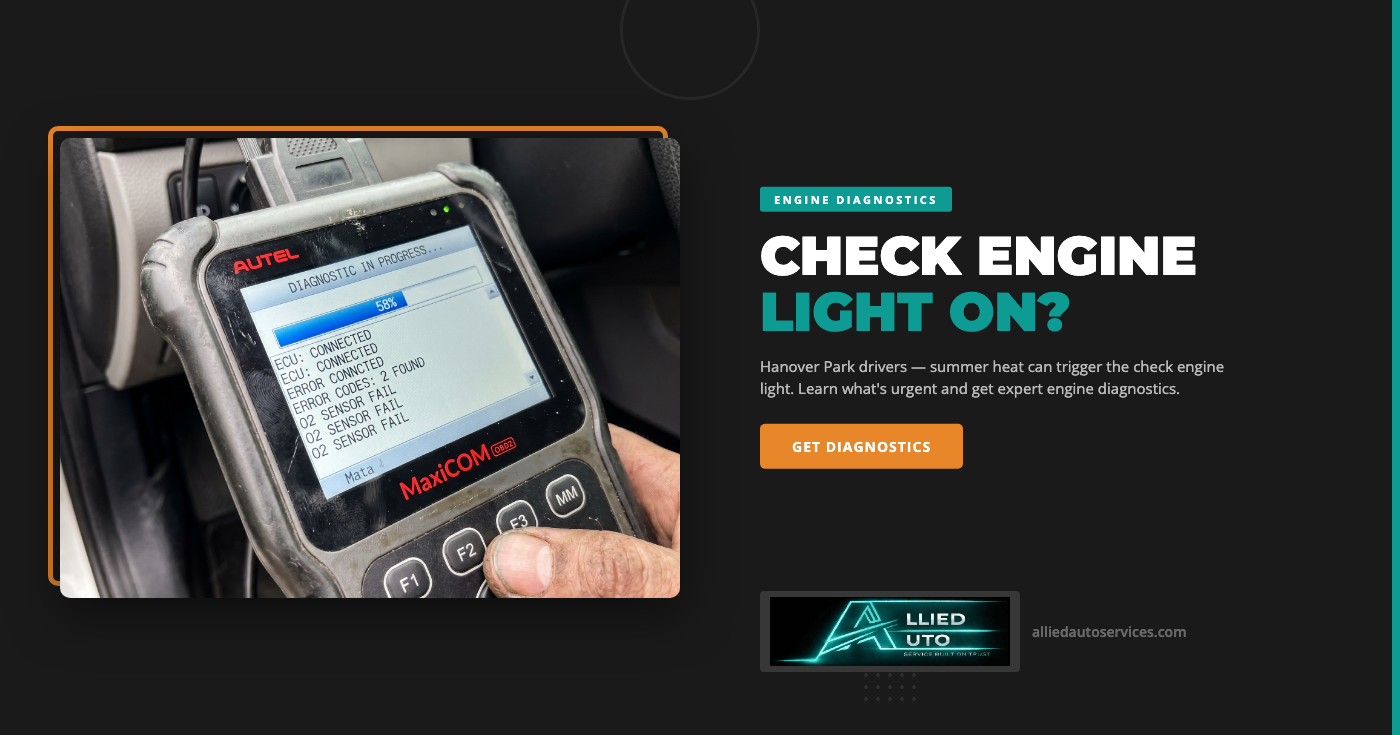
Because one light stands in for hundreds of possible codes, guessing at the cause is a losing game. When a driver brings us a vehicle with the light on, the first thing we do is connect a scan tool and read the stored code. That code points us toward the system that flagged the problem so we can investigate with facts instead of assumptions. What the light can tell you on its own, though, is how urgent the situation is—and that comes down to whether it's glowing steadily or flashing.
Why Summer Heat Can Trigger the Check Engine Light in Hanover Park
Hanover Park summers bring heat, humidity, and long stretches of stop-and-go traffic on the way to work or the tollway—and all three put extra strain on the systems your OBD-II computer is watching. It's no coincidence that we see more check engine lights in July and August than in the milder months.
The most common heat-related trigger is also one of the most overlooked: the gas cap. When temperatures climb, the fuel in your tank expands and gives off more vapor, which raises the pressure inside a sealed fuel system. Your car's evaporative emissions (EVAP) system is designed to capture those vapors before they escape into the air. If the gas cap is loose, cracked, or has a worn seal, that pressure balance breaks down, and the engine control module reads it as an emissions leak—so it turns on the light. The Car Care Council notes that a loose gas cap alone can trigger the "Check Engine" or "Service Engine Soon" light. Tightening the cap until it clicks often solves it, though the system may need a day or two of normal driving to recheck the pressure and switch the light back off.
Heat works on other components, too. Oxygen sensors and coolant temperature sensors live in a hostile, high-temperature environment that only gets harsher in summer. Your battery loses capacity as heat accelerates the chemistry inside it, and voltage irregularities can throw codes of their own. And on a 90-degree Hanover Park afternoon, an engine that's already running warm has far less margin before the cooling system falls behind—an overheating engine is one of the fastest ways to light up the dash.
Common Causes Behind the Light for Illinois Drivers
While summer has its signature triggers, the check engine light in Hanover Park vehicles can point to any number of issues year-round. Some of the ones we diagnose most often for local drivers include a failing gas cap or a small EVAP system leak; a worn oxygen sensor, which skews the air-to-fuel mixture and quietly drags down your gas mileage; and spark plugs or ignition coils that have reached the end of their service life and started causing a misfire.
Further down the line, we see mass airflow sensors that have drifted out of range, catalytic converters that have been damaged—usually by a misfire or a rich fuel condition that went unaddressed for too long—and charging-system problems that show up as electrical fault codes. A coolant temperature sensor giving a bad reading can trigger the light while also confusing the engine's fuel and timing decisions, which is especially easy to overlook during a hot Illinois stretch.
The pattern worth remembering is that these problems rarely announce which one you have. Two vehicles with an identical light on the dash can need completely different repairs. That's exactly why the diagnostic step matters so much, and why reading the code is the starting point of every engine diagnostic we perform for Illinois drivers rather than the end of it.
Solid Light vs. Flashing Light: How Urgent Is It?
One of the most common questions we hear from Hanover Park drivers is whether they can keep driving with the light on. The most useful answer starts with a simple observation you can make yourself: is the light glowing steadily, or is it flashing?
A steady, solid light means the system has found a problem that needs attention but isn't an immediate emergency. A loose gas cap, an aging oxygen sensor, or a minor emissions fault will usually show up this way. In most cases you can continue driving normally and schedule an engine diagnostic within the next few days—just don't let "a few days" turn into a few months. Even a minor fault can grow into a larger repair the longer it runs.
A flashing or blinking light is a different story entirely. It signals an active engine misfire, which means unburned fuel is being pumped into your exhaust system. There it can superheat and destroy the catalytic converter—one of the more expensive components on your vehicle—in a matter of minutes. If your light is flashing, ease off the accelerator, reduce your speed, and get the vehicle to a shop right away, or call for a tow rather than pushing on. The same urgency applies any time the light appears alongside symptoms like shaking, stalling, a loss of power, a rising temperature gauge, or an unusual smell. When those show up, treat the situation as time-sensitive no matter how the light is behaving, and reach out to us so we can protect your engine before the damage spreads.
Why You Shouldn't Ignore or Just Reset the Light
It's tempting to reach for the quick fix—disconnect the battery, or clear the code with a handheld reader, and watch the light disappear. The problem is that clearing the code doesn't repair anything. The underlying fault is still there, and once the OBD-II system runs its checks again, the light comes right back on, often within a drive or two. Meanwhile, whatever set it off keeps doing its damage in the background.
Ignoring the light carries a real cost. An unaddressed misfire can ruin a catalytic converter. A failing oxygen sensor left in place wastes fuel tank after fuel tank and can eventually take that converter down with it. What starts as a modest repair has a way of turning into a much larger one. The U.S. Department of Energy's fueleconomy.gov puts it plainly: a check engine light could point to a more serious issue that could reduce your fuel economy, increase emissions, and lead to costly repairs later.
There's an Illinois-specific angle, too. An illuminated malfunction indicator lamp causes an automatic failure on the OBD-II emissions test used across the Chicago metro area, so clearing the code right before a test won't get you through—the system needs to complete its readiness checks first, and a vehicle with an active fault won't pass. Staying ahead of these issues with regular Preventative Maintenance is the surest way to keep the light off for Hanover Park drivers in the first place, and to give yourself real peace of mind behind the wheel.
What to Expect During Professional Engine Diagnostics
When you bring your vehicle to us with the check engine light on, the process starts with a professional scan of the OBD-II system to retrieve every stored trouble code. But a code is a clue, not a conclusion. It names the circuit or system that reported a problem—it doesn't automatically tell us which part failed or why. Replacing components based on the code alone is how drivers end up paying for parts they never needed.
Instead, our ASE Master-certified technicians read the code alongside live sensor data, a hands-on visual inspection, and targeted testing to trace the fault to its true root cause. Because our technicians aren't paid on flat-rate commission, there's no incentive to pile on repairs you don't need—just an accurate diagnosis and a straight explanation. Every visit includes a digital inspection, so we send photos and short videos to your phone showing exactly what we found. You see what we see, and we walk you through what's urgent, what can wait, and what it will cost before we touch a wrench.
We'll give Hanover Park drivers an honest recommendation and a clear estimate up front, and any parts we install are backed by our 3-year/36,000-mile warranty. If your car needs to stay with us, we offer loaner and rental vehicles so a check engine light never leaves you without a way to get around Hanover Park. A focused diagnostic is a smart investment—it replaces guesswork with answers and often spares you a far bigger bill down the road.
Trust Allied Auto Services for Engine Diagnostics Near Hanover Park
A check engine light in Hanover Park, IL doesn't have to ruin your week or drain your wallet—as long as you don't ignore it and you don't just reset it and hope. Whether it turns out to be a two-minute gas cap fix or a genuine engine repair, the smartest move is to find out what's really going on before summer heat turns a small problem into a large one.
At Allied Auto Services, Hanover Park drivers get thorough, transparent Engine Diagnostics from a family-owned shop that has been earning trust in the area since 2001. Twenty-five years of experience, ASE Master-certified technicians, digital inspections you can see for yourself, and a no-pressure culture that puts the right repair ahead of the biggest ticket—that's what keeps our neighbors coming back, and it's part of why we're a Costco Auto Care Center partner.
If your check engine light is on—steady or flashing—don't guess and don't wait. Schedule your engine diagnostic with Allied Auto Services today, and get back to enjoying your Hanover Park summer with confidence instead of a warning light on the dash.