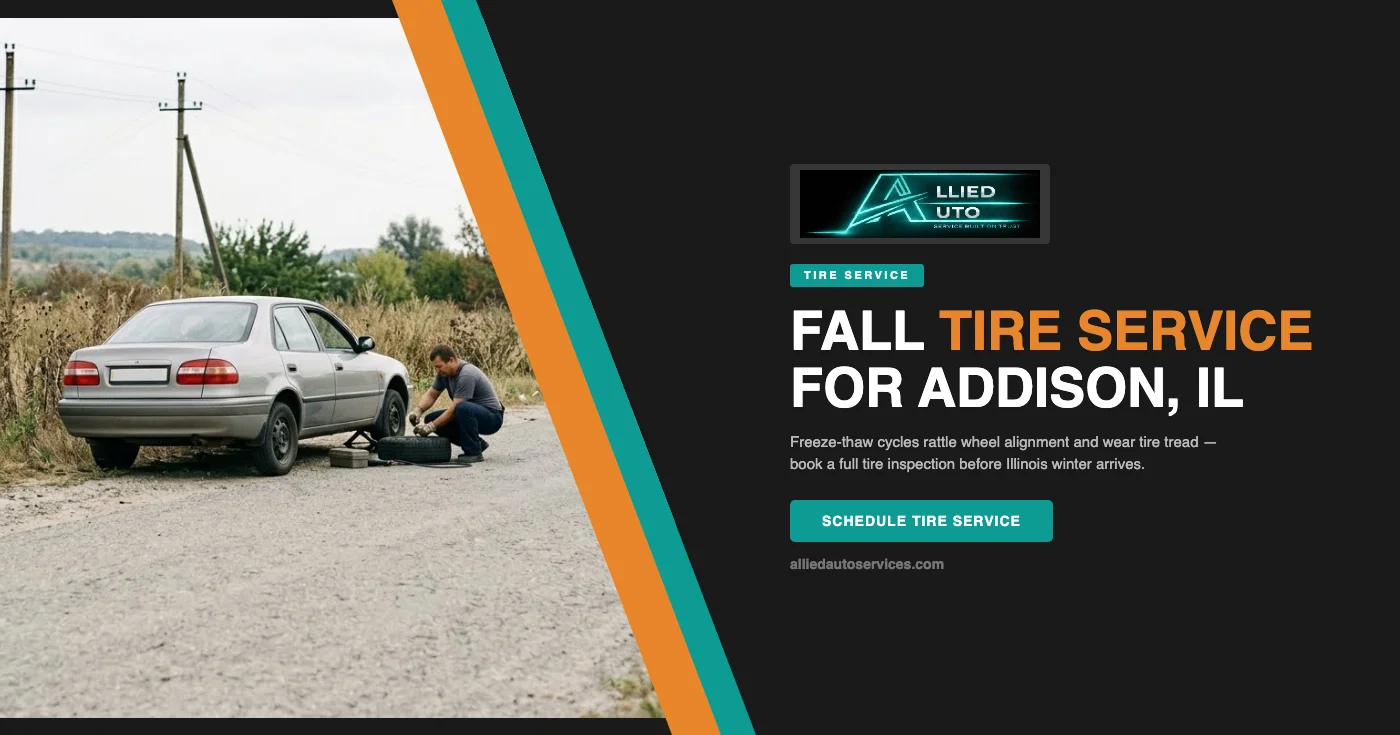
Fall Tire Prep for Addison, IL Drivers: How to Know If Your Tires Are Ready for Illinois Winter
September in Addison, IL still feels like summer in the middle of the afternoon, but the mornings tell a different story — that crisp step out to the driveway, the extra second the engine takes to settle, the way the road feels a bit stiffer under your tires on the drive to work. Fall is the shoulder season when your vehicle transitions from summer heat to the very different demands of Illinois winter, and the four contact patches carrying that transition are your tires. This is the window when a proactive tire service in Addison, IL pays for itself — a rushed December visit after the first slush is costlier and more stressful than a calm September appointment. At Allied Auto Services, we've helped our Addison, IL neighbors get their vehicles winter-ready for 25 years, and pre-winter Tire Service & Alignment is one of the best hours of maintenance a driver can invest before the first hard freeze.
Why Fall Is the Right Time to Inspect Your Tires in Addison, IL
Illinois weather rarely eases into winter. In a typical fall around Addison, IL, daytime highs slide from the 80s in early September into the 40s by late October, and overnight lows begin to flirt with the 20s well before Thanksgiving. Every one of those swings puts direct pressure on your tires. Rubber compounds get stiffer as the temperature drops, air molecules contract, and the road surface itself changes character — asphalt that felt grippy in August turns hard and unforgiving on a 30-degree morning. Tires that felt fine all summer can start showing weakness the first time a real cold snap hits.
The most common seasonal surprise Addison drivers experience is a tire-pressure warning light on a cold morning that wasn't on the day before. That is not a defect — it's physics. Tires lose roughly one PSI of pressure for every ten degrees Fahrenheit the temperature drops, so a tire that was properly inflated at 35 PSI on a 70-degree afternoon can be sitting at 30 PSI on a 20-degree morning. Underinflated tires ride on their outer shoulders instead of the full tread, wear unevenly, run hotter, and shorten stopping distance right when Illinois winter roads demand more of them. A pre-winter visit sets your pressures to spec, resets the TPMS, and gives you a baseline you can trust as the temperature keeps sliding.
The Tread Depth Standard That Separates Road-Ready Tires From Worn Ones
The legal minimum tire tread depth in the U.S. is 2/32 of an inch — the point at which the wear indicator bars molded into the tread become flush with the surrounding rubber. That number, however, is the point at which a tire is legally worn out, not the point at which it stops performing well in bad weather. Wet-weather stopping distance climbs sharply well before a tire reaches 2/32, and snow traction falls off even faster. For Illinois winter driving, the widely accepted replacement threshold is 5/32 of an inch — nearly two and a half times the legal minimum.
You can do a rough check at home with the penny test — insert a penny into the tread with Lincoln's head pointing down, and if you can see the top of his head, you're at or below 2/32 and the tire is finished. A better winter check is the quarter test — with Washington's head pointing down, if you can see the top of his head, you're at or below 4/32 and the tire is approaching its winter limit. During your tire service in Addison, IL our technicians measure each tire's tread depth with a calibrated gauge and share the numbers with you on the digital inspection report — you'll see the actual depth on each corner, not a verbal "looks fine." Bridgestone's tread-depth guide is a useful companion reference if you want to check your own tires between visits, and it confirms the same 2/32 legal-limit and 4/32-quarter-test benchmarks we use in the bay.
How Illinois Freeze-Thaw Cycles Damage Wheel Alignment
Winter's most underrated attack on a vehicle is not snow — it's the freeze-thaw cycle that begins in late fall and continues into spring. Water seeps into small cracks in the pavement, freezes overnight, expands, and pries the asphalt apart. By morning the crack is a chip; a few cycles later the chip is a pothole. Illinois roads are famously good at producing them, and every Addison, IL driver knows the sound of a hard hit against a pothole rim they didn't see in time.
What that impact does to your wheel alignment is often invisible until you're already halfway into the season. A single sharp pothole hit can move a control-arm bushing, tweak a toe setting, or bend a wheel enough to push the alignment out of its factory specification. The first thing you feel is usually a slight steering-wheel pull to one side on a straight highway or a steering wheel that sits a few degrees off-center when the wheels are pointed forward. The second thing that happens — and the one that costs the most money — is uneven tire wear. Alignment that is out of spec by even a small amount will scrub the inside or outside shoulder off a set of tires in one Illinois winter, turning a good set of tires into a replacement job by spring. A pre-winter tire service in Addison, IL includes a check for the tell-tale wear patterns and a printed alignment reading, so any drift is caught before the tires pay for it.
All-Season vs. Winter Tires: What Addison Drivers Should Weigh Before Deciding
For most Addison, IL drivers, a good set of all-season tires with plenty of tread depth is enough to handle a normal Illinois winter. Modern all-seasons are engineered for a wide range of conditions, including light snow and cold pavement, and the newer three-peak-mountain-snowflake-rated all-weather category has narrowed the gap even further. The trade-off is straightforward: all-season tires give up some grip in deep snow and single-digit temperatures in exchange for not needing to be swapped twice a year.
Dedicated winter tires exist because rubber chemistry matters. The compound in a true winter tire stays flexible in freezing temperatures where an all-season compound stiffens and loses traction, and the tread pattern is cut with more sipes — the small slits that bite into snow and evacuate water. If your commute takes you well outside Addison into rural stretches, if you drive a rear-wheel-drive vehicle, if you tow, or if you simply want the shortest possible stopping distance on the coldest mornings, a set of four winter tires mounted on a second set of wheels is the real upgrade. Winter tires must be installed as a full set of four — mixed pairs make a vehicle handle unpredictably. During your visit we'll walk through your actual driving pattern and help you decide whether an all-season set with fresh tread will carry you through, or whether a dedicated winter set makes sense for how and where you drive.
What a Full Tire Service Inspection Covers at Allied Auto Services
A tire service in Addison, IL is more than a quick look at the tread. When you bring your vehicle in for pre-winter tire service, our ASE Master-certified technicians go through a documented checklist and send you photos and short videos of what we find — no verbal descriptions to trust. The inspection begins with tread depth on each corner, measured with a gauge and recorded. We check pressure against your vehicle's placard spec (the yellow-and-white sticker on your driver's door jamb), correct any tire that's out of range, and reset the TPMS so no false warnings follow you into the season.
From there we examine the sidewalls for cracking, dry rot, or impact damage — sidewall bulges require replacement, not repair. We check the valve stems for cracks (a common cause of slow pressure loss on older wheels), inspect the wheel weights and rims for pothole damage, and read the tires' wear patterns for the alignment and suspension clues described above. Because your tires don't live in isolation, the tire service visit is the right moment to check the systems that keep them working: brakes, since braking distances get longer on cold and wet roads; the battery, which loses cranking capacity as temperatures fall; coolant and heater performance; wiper blades and washer fluid rated for Illinois cold; and any warning lights the vehicle has been carrying. Any check-engine light or drivability concern can be pulled and diagnosed during the same visit with our Engine Diagnostics service, so you're not making a second trip when the light returns in December. The U.S. Department of Energy's fueleconomy.gov puts it plainly — "you can improve your gas mileage by 0.6% on average — up to 3% in some cases — by keeping your tires inflated to the proper pressure" — one of the smallest maintenance items with one of the biggest year-round returns.
Why Tire Rotation and Balance Matter Before Illinois Winter Sets In
Tire rotation is the single most important thing a driver can do to extend the life of a set of tires, and it is the item most commonly skipped when the weather is good. Front and rear tires wear at different rates because they carry different loads and do different jobs — front tires steer and typically handle more braking force, and on front-wheel-drive vehicles they also put the power down. Left unrotated, the front pair will reach the end of its life while the rear pair still has thousands of miles of tread left, and you'll be forced to replace either two tires early or all four at once. Rotating every 5,000 to 7,500 miles keeps wear even and lets a full set of tires reach the end of their service life at the same time.
Balance is the quieter half of the same conversation. Every tire and wheel assembly has small weight variations from the manufacturing process, and small wheel weights are added to counteract them so the assembly spins true at highway speed. Those weights can be knocked off by a pothole, and the balance itself can shift as a tire wears. An out-of-balance tire feels like a steering-wheel vibration or a seat vibration at a specific speed — typically between 55 and 70 mph — and if left alone it accelerates uneven wear, particularly on the corner it lives at. Before winter, when snow and slush already make the road less predictable, an out-of-balance wheel adds instability you don't need. Pre-winter tire service in Addison, IL that includes a rotation and a re-balance costs a fraction of what a prematurely worn set of tires costs to replace, and it makes the entire vehicle feel steadier on the coldest, wettest days of the season.
Book Your Fall Tire Service at Allied Auto in Roselle
The Addison-to-Roselle drive is short — about ten minutes down Lake Street — and it's the trip that saves our Addison, IL neighbors real money every winter. Since 2001, Allied Auto Services has been the family-owned shop that Addison, Roselle, and the surrounding communities count on for auto repair done right. Our ASE Master-certified technicians are not paid on flat-rate commission, which removes the built-in incentive to pile on services you don't need — when we recommend something during your tire service, it's because we saw it on the digital inspection and can show you the photo. Every visit includes that digital inspection sent to your phone, straightforward pricing before we start the work, a 3-year/36,000-mile warranty on parts we install, and loaner and rental cars if your vehicle needs to stay with us for the day. As a Costco Auto Care Center partner, we bring an additional layer of trust and value on qualifying work — and every customer gets the same no-upselling culture our neighbors have counted on for 25 years. Schedule your pre-winter tire service in Addison, IL with Allied Auto Services today, and head into the season with peace of mind instead of a dashboard warning.